Volume take-off
GeometryHelper.Takeoff takes off the volumes of the parts of a model with each bit of material counted once. Where
a slab, a beam and a column meet, the block the three share belongs to the one ranked first, and the others lose it
once: the net volumes add up to the volume of all the parts together. The bodies given are never cut; only what they
share is.
Quick start
using GeometryHelper;
using GeometryHelper.Takeoff;

var items = new List<VolumeItem>
{
    new VolumeItem(slab,   "SLAB",   1),
    new VolumeItem(beam,   "BEAM",   2),
    new VolumeItem(column, "COLUMN", 3),
};

VolumeTakeoffResult[] results = VolumeTakeoff.Run(items);            // in the order of the items

foreach (VolumeTakeoffResult result in results)
{
    double m3 = result.NetVolume / 1E9;                               // mm3 to m3
    if (!result.IsExact) { /* result.Issues says what and which way */ }
}
VolumeTakeoff.Run(items, options) takes a VolumeTakeoffOptions: the SolidBooleanOptions every common part is
worked out with, and MaxDegreeOfParallelism, -1 for every processor (the default) or a count.
Who keeps the overlap
The higher Priority keeps what two parts share and cuts it out of the lower. Of two the same, an item given an Id,
new VolumeItem(solid, name, priority, id), keeps it from one without, the larger id from the smaller, and otherwise
the item earlier in the list. A Tekla part's Identifier.ID given as the id makes ties go as HDC WBS's WBSCalculator
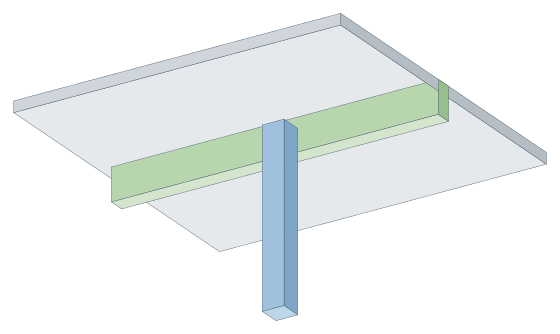
takes them, the larger id cutting. Here the column keeps most: columns 3, beams 2, slabs 1. A column 400 by 400 and 3 200 high, a beam 300 wide, 600 deep and 6 000 long running through it,
and a slab 6 000 by 6 000 by 200 on both, their tops flush:
| Part | Gross | Taken off | Net |
|---|---|---|---|
| column | 0.512 m3 | 0.512 m3 | |
| beam | 1.080 m3 | 0.072 m3 to the column | 1.008 m3 |
| slab | 7.200 m3 | 0.032 m3 to the column, 0.336 m3 to the beam | 6.832 m3 |
 |
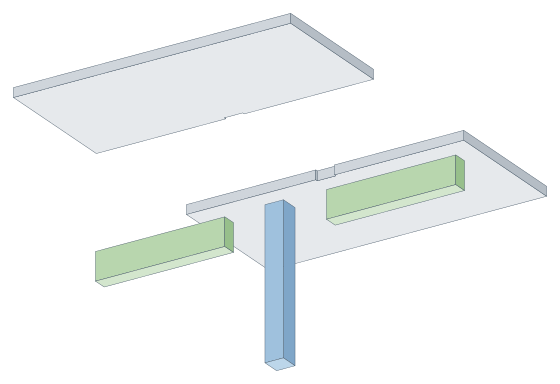 |
| The parts as given, from below | What each keeps, drawn apart |
The beam runs through the whole depth of the slab, so what the slab keeps is two pieces 6 000 by 2 850, each with a notch 400 by 50 for the column; the beam keeps two pieces 2 800 long, one either side of the column.
The beam shares 0.360 m3 with the slab, but 0.024 m3 of it, the block 300 by 400 by 200 inside the column, is the column's already: taken off by each part it meets, the slab would lose it twice. The three nets add up to 8.352 m3, the volume of the three together. Two exact copies count once, the later coming out nought, and so does the same body given twice; a part wholly inside one ranked before it comes out nought.
What comes back
| Property | Meaning |
|---|---|
GrossVolume |
the part's own material, its openings cut out |
Deductions |
what each part ranked before it kept, ByIndex and Volume, in the order of their ranks |
DeductedVolume |
the deductions added up |
NetVolume |
gross less deducted, held between nought and the gross |
Issues |
what could not be worked out exactly, naming the other item by its index |
IsExact |
no issues |
A null entry in the items gets a result with no item, every volume nought and the issue "no item".
How it is worked out
Each pair whose boxes overlap by more than the point tolerance has its common part worked out by TryIntersect of the
part ranked later with the part ranked first, which is put onto it as the contact says. Then each part's pieces, in
the order of their keepers, have the pieces before them taken out by TrySubtractAll, so that each deduction is what
that keeper took and no keeper before it. A common part thinner on average than half the point tolerance is taken as
touching: a beam flush under a slab loses nothing. Both steps run in parallel, the heaviest work first, and the
numbers are the same, bit for bit, on one thread or on every processor.
A common part the booleans cannot make, one that is not valid, holds more than the smaller part, or throws, is worked out by slicing instead: the part is cut by parallel planes across the axis that needs the fewest, and the area of its material within the keeper and outside every keeper ranked before is added up across them. Between two planes with no corner, no edge through a face and no three faces meeting, the area is a polynomial of the second degree, so three sections a layer give it exactly, and nothing is snapped to a tolerance. A piece whose cut of the pieces before it skips one, or throws, or that has a keeper before it whose overlap was sliced, is sliced the same way. On a Tekla model a curved wall of 354 faces and a curved girder of 322, their sides 0.16 to 0.48 apart and 0.05° off, share a common part the booleans give as 4 256 faces, not valid, after a minute or two; slicing gives 2 226 236 967 mm3 in 0.04 seconds, the same across any of the three axes, where Tekla's own boolean gives 2 226 236 773 cutting the wall and 2 226 236 807 cutting the girder.
A pair as near-coincident as these two is not given to the booleans at all. Where at least a hundred pairs of a face of the part ranked later and a face of the keeper stand beside each other, less than a tenth of a degree off parallel though not parallel within the vector tolerance, every corner of the keeper's face within a millimetre of the other's plane and further from it than the point tolerance, the pair goes straight to slicing. The curved wall and girder have 383 such pairs; of the other 51 208 pairs of the model the most any has is 86, and the booleans make every one of them.
Two curved parts faceted at different stations are not near-coincident: their faces cross each other at small angles rather than standing beside each other, and the booleans make them. A spiral ramp 7 600 wide and 300 thick in 56 facets over half a turn, and a spiral girder 600 by 500 in 66 lying 100 into its outer edge, ranked under it, are taken off in 1.2 seconds on .NET 10 and 3.0 on .NET Framework 4.8, the girder losing the 65 400 402.028 cubic millimetres slicing gives. The booleans used to cut the girder by each plane of the ramp wherever it ran, into hundreds of thousands of cells, not only where its faces are (see space), and took 41 and 90 seconds over it. An opening of either part that shares no space with the other is left out of their common part: with a spiral tube inside the ramp as an opening, 80 under the girder's top all along it, the common part was cut into 29 681 cells, the tube cut in; it is cut into the 18 345 of the ramp without it, and the girder loses the same 65 400 402.028.
On a real model
A Tekla Structures model of 30 921 parts, read closed, ranked columns 8, walls 7, girders and beams 6, slabs 5, stairs 4, grout and base plates 3, steel fittings 2 and formwork 1, holds 69 040.90 m3 gross. Taken off with the contact and the fallback that suit a Tekla model in millimetres,
var options = new VolumeTakeoffOptions(new SolidBooleanOptions(
    Tolerance.Default,                                                   // 0.001
    0.01,                                                                // contact
    new Tolerance(0.01, 0.01, Tolerance.DefaultEqualAngleRad, 0.01)));   // fallback
it loses 1 671.73 m3 to the parts ranked before and keeps 67 369.17 m3 net, and not one of the 30 921 results carries
an issue: the common parts the booleans cannot make, the curved wall and girder above among them, are sliced. Cutting each part
with every part ranked before it that it meets, by TrySubtractAll with the same options, skips 23 cuts on 6 parts and
leaves that overlap in. The run takes 197 seconds on 24 processors and 328 on one, with the same numbers to the last
bit; the booleans used to spend two minutes failing on the curved pair before it was sent straight to slicing. Without
the contact it takes 59 seconds and keeps 67 369.16 m3, also with no issue, 8.5 litres less: the micron-thin sheets
Tekla leaves between parts, which the contact takes as touching, are taken off.
What is promised, and what is not
- The net volumes add up to the volume of the parts together, within the tolerance and the contact: an overlap thinner than either comes back as touching and is not taken off.
- A common part the booleans cannot make is worked out by slicing, exactly over flat faces, and carries no issue. Slicing snaps nothing, so a sheet thinner than the contact, which the booleans put away as touching, is taken off as the faces give it: 194 mm3 more than Tekla on the curved pair.
- A pair that cannot be sliced either is not taken off: the net volume is then an upper bound, and the issue says so.
Slicing needs every section crossed an even number of times, so it refuses a body with a corner more than about 1E-9
off its neighbour's edge, a T-junction, even where
Validateaccepts the body. - A common part is checked to be valid and to hold no more than the smaller part. Nothing bounds it from below, so a
valid body can still have lost part of what the two share; for a take-off that matters, compare against the net bodies
TrySubtractAllcuts. - Only volumes are taken off. A formwork area, or the net bodies themselves, come from cutting each part by the parts
ranked before it:
GeoSolid3.TrySubtractAll, with closing where a cut would be skipped.